Early Career Professionals How To Toolkit
How to Develop Your Professional Self
What is one’s professional identity?
Your professional identity is how you show up in your field—it’s the combination of your values, strengths, expertise, reputation, and how others perceive you. In public health, it’s not only about what you do or your technical skills, but why and how you do it.
A clear professional identity can guide your focus, communicate your value, and anchor your career decisions. It answers questions like:
-
- What contribution do I want to make in public health?
- What issues do I care about?
- Which skills or roles best match my passion and strengths?
Knowing Who You Are
From Your Public Health Career Workbook
Building Blocks for a Purpose-Driven Career: Your Foundation
Your foundation is your core self-awareness–understanding your values, interests, strengths, and what drives you professionally. It’s the essential knowledge about yourself that guides career decisions and helps you communicate authentically about what you bring to the field.
In this building block, you will complete a self-study, walking through six steps designed to help you:
-
- Know Your Why
- Clarify Your Values
- Explore Your Interests
- Identify Your Strengths
- Understand Your Capabilities
- Set Your Career Vision
Your Public Health Skillset
Public health draws on many disciplines—health sciences, social sciences, policy, communication, and more. Public health work is interdisciplinary and dynamic. Professionals working in public health today need both mastery of core competencies and specialized skills–and a willingness to learn new things and adapt to change.
Example in demand skills for public health professionals today.
As the field of public health evolves, and as communities change, new skills and areas of expertise—such as climate health, health informatics, data science, implementation science, and public health law and advocacy—become increasingly valuable. A broad and adaptable skillset can help public health professionals meet the complex and interconnected challenges of the day. With a strong skillset, you can work across disciplines, respond to emerging threats, and stay effective as policies, technologies, and community needs change.
Your skillset is not fixed: it will expand as your experience deepens. With every job, project, and training you take on, you are developing your skillset. The core competencies, specialized skills, and professional experience you have are hallmarks of your professional identity.
Get Started Guide
Building Your Professional Brand
Your professional brand is not about slick marketing—it is about showing up consistently in ways that reflect your values, expertise, and identity. Your brand is the unique mix of skills, experiences, values, and personality that sets you apart and signals what you care about. A strong brand is authentic, intentionally developed, and consistently communicated—whether online, in person, or through your work. Cultivating your brand helps you stand out, build trust, and open doors to new opportunities as your career grows.
Presenting Your Unique Self
From Your Public Health Career Workbook
Building Blocks for a Purpose-Driven Career: Your Brand
In public health, where trust, credibility, and mission alignment are crucial, having a clear, authentic professional brand can differentiate you in a competitive job market, attract opportunities that align with your values and goals, and amplify your impact by expanding your reach and influence.
In this building block, you will move from unconscious to intentional branding through four key steps:
-
- Assess Your Current Brand
- Develop Your Brand Essentials
- Upgrade Your LinkedIn Profile
- Enhance Your LinkedIn Presence
Featured Tools
Explore these tools for practical steps to define your strengths, clarify your values, and consistently communicate an authentic professional brand. They were developed by Dr. Johanna Andrews Adlam, Ph.D., MPH, CPCC, ACC, Founder & CEO of Premexcellence®, and are shared here with her permission.

Build Your Brand: Passion, Purpose, and Presence to Propel Your Career
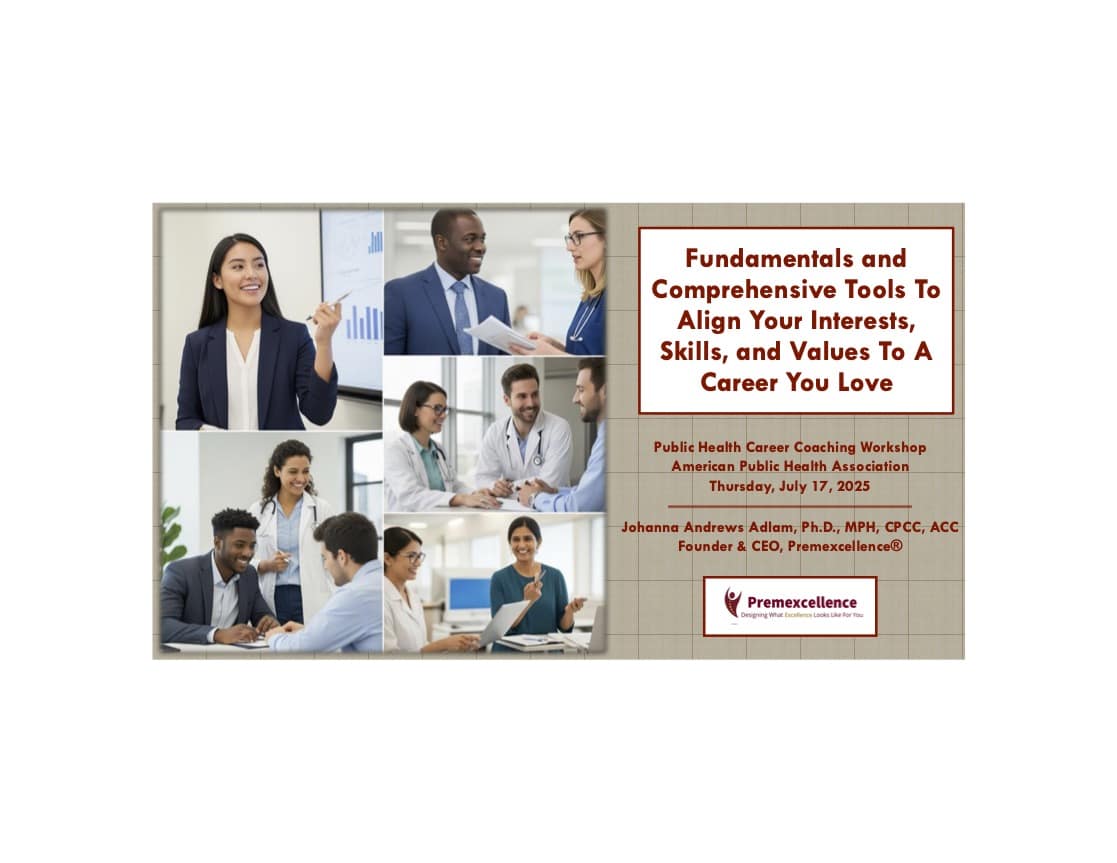
Fundamentals and Comprehensive Tools to Align Your Interests, Skills, and Values to a Career You Love

Books of Values Exercise

Personal Branding Worksheet
Build Your Network
Building your professional network opens doors to mentorship, collaboration, and career growth. For early career professionals, connections can provide guidance, lead to new opportunities, and help you stay current in the field. Networking takes many forms—joining professional associations, participating in community events and conferences, or engaging in webinars and virtual gatherings. The key is to approach it as relationship-building: show genuine interest, exchange contact information, and follow up. Over time, these relationships become a lasting foundation of support and opportunity throughout your career.

Get Exposure and Get Noticed
Present Your Work
Presenting your work strengthens your resume, communication skills, and professional credibility while contributing to shared learning in your field. For early career professionals, they are especially helpful to practice at explaining your ideas clearly and get feedback to refine your work. Opportunities are everywhere–meetings of your department or organization, local events sponsored by community-based organizations or local chapters of professional associations, or professional or academic conferences. Presentations can take many forms–from traditional talks, Q&As, roundtables, workshops, lightning talks, poster sessions, and more. Often, the first step is submitting an abstract in response to a call for presentations.
Publish Your Work
As with presenting, publishing your work grows your professional repertoire while also giving your ideas wings. Writing can help you reach new audiences, and establish your voice in the field. lends your voice to the field. Opportunities include blog posts, op-eds, newsletters, articles in periodicals or peer-reviewed journals, and a range of other kinds of publications in various outlets. Some outlets issue calls for publications, while others accept submissions on a rolling basis. If you have something to share, explore different options to find the right fit. You can start small by adapting a presentation or longer piece into a short article or blog post. Partnering with colleagues as a co-author is another approachable way to begin. Posting your work on open-access platforms or sharing through LinkedIn can broaden its reach. Since many outlets ask for an abstract or blurb, being able to summarize your work clearly is a helpful step toward getting published.
Attend a Conference
Conferences are a great way to grow your network, learn about emerging issues, and stay current in your field. For early career professionals, they offer valuable exposure to new ideas, potential collaborators, and career opportunities. Conferences come in many sizes—regional, virtual, or national—and all can offer meaningful opportunities to learn and connect. You might also consider submitting to present—most conferences welcome contributions from professionals at every stage of their career. Make the most of the experience by planning ahead: review the agenda, identify sessions that align with your interests, and reach out to peers or presenters with whom you would like to connect. Volunteering as a moderator, note-taker, or student ambassador is another way to get involved, gain visibility, and contribute to the event.
The latest public health &
equity content
Straight to your inbox